.png)
My Child Is Self-Harming or Having Suicidal Thoughts: What Parents Need to Know
Updated: 2 days ago

Hearing your child say, “I keep thinking about killing myself,” discovering that they have been hurting themselves, or learning that they are afraid they might hurt themselves can be terrifying for a parent.
Your first instinct may be to determine one thing: Is my child suicidal? That is an important question but sometimes the clinical picture is more complicated.
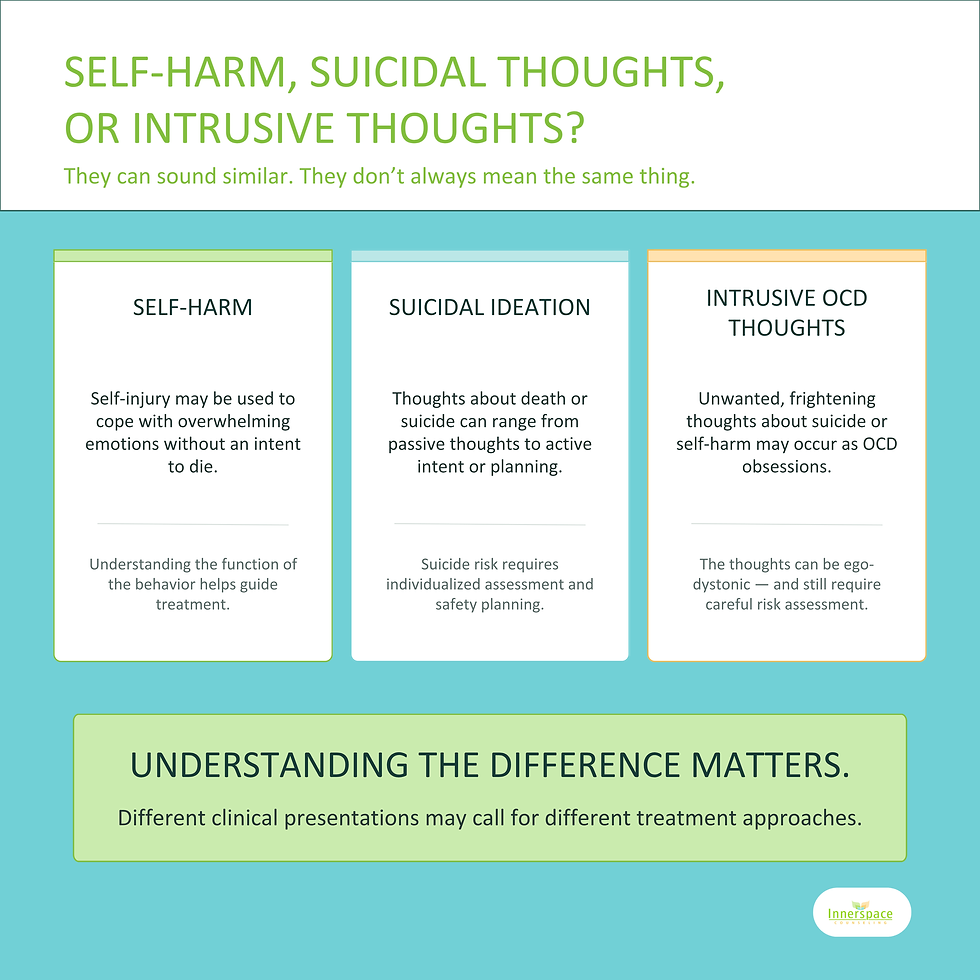
Thoughts about suicide or self-harm can occur with depression and genuine suicidal ideation. They can also appear as unwanted, intrusive thoughts or obsessions in obsessive-compulsive disorder (OCD). Self-harm itself may occur without an intention to die. Some young people can experience more than one of these concerns at the same time.
Understanding what the thought means, how the young person experiences it, what happens in response to it, and whether there is intent to die can be critically important in determining the appropriate treatment. This is why careful assessment matters.
At Innerspace Counseling, our Adolescent Intensive Outpatient Program and Partial Hospitalization Program (IOP/PHP) offer specialized tracks for DBT-informed Mental Health care and ERP based OCD & Anxiety care. This distinction is particularly important when working with young people who report thoughts involving suicide or self-harm. A symptom that sounds similar on the surface may have a very different clinical function and may require a very different treatment approach.
First: When Suicide Risk May Be Immediate
If your child has attempted suicide, is in immediate danger, or is experiencing suicidal thoughts with current intent to act, seek emergency assistance. Call or text 988 to reach the Suicide & Crisis Lifeline. If there is an immediate life-threatening emergency, call 911 or go to the nearest emergency department.
Do not leave a young person who is at imminent risk alone while obtaining emergency assistance.
This article provides general education and cannot determine whether an individual child is experiencing suicidal ideation, OCD-related intrusive thoughts, nonsuicidal self-injury, or another mental health condition. An individualized assessment by a qualified professional is necessary.
Self-Harm, Suicidal Ideation, and Intrusive Suicidal Thoughts Are Not Necessarily the Same
One of the most important things parents can understand is that the content of a thought does not, by itself, tell us its clinical meaning.
Consider three young people who each disclose something involving self-harm or suicide. One may be intentionally cutting because physical pain temporarily relieves overwhelming emotions. Another may be experiencing depression, hopelessness, thoughts of dying, and actual suicidal intent. A third may be terrified by repetitive, unwanted thoughts such as “What if I lose control and kill myself?” or “What if I secretly want to die?”
Those experiences should all be taken seriously, but they are not automatically the same clinical presentation. Research examining suicidal obsessions in OCD emphasizes the importance of distinguishing unwanted suicide-themed obsessions from suicidal ideation because the clinical formulation and appropriate treatment may differ substantially.
What Is Nonsuicidal Self-Injury?
Nonsuicidal self-injury (NSSI), commonly called self-harm, involves intentionally injuring oneself without the intent to die. Behaviors can include cutting, scratching, burning, hitting oneself, or interfering with wound healing.
For some young people, self-harm temporarily functions as a way to reduce overwhelming emotional intensity, interrupt numbness or disconnection, express feelings they cannot put into words, redirect emotional pain into physical sensation, respond to shame or self-criticism, or create a temporary sense of control.
That temporary emotional relief can reinforce the behavior, making self-harm more likely to become a repeated coping strategy. Treatment therefore should not focus only on “How do we make the behavior stop?” An equally important question is: “What is this behavior doing for this young person, and what safer skills can help meet that need?”
What Is Suicidal Ideation?
Suicidal ideation refers to thoughts about ending one’s life. These thoughts can differ considerably in frequency, intensity, duration, intent, planning, access to means, and likelihood of acting.
When evaluating suicide risk, clinicians consider much more than whether the word suicide appears in someone’s thoughts. Assessment may explore whether the person wants to die, has current suicidal intent, has considered or rehearsed a plan, has access to a contemplated method, has previously attempted suicide, what is keeping them from acting, what protective factors and supports are present, and whether there are changes in mood, behavior, functioning, substance use, or other psychiatric symptoms.
When “What If I Kill Myself?” May Be an OCD Intrusive Thought
OCD can involve intrusive thoughts, images, sensations, impulses, or doubts about subjects that are deeply frightening to the individual. For some people, suicide or self-harm becomes the theme of the obsession.
Examples may include: “What if I suddenly jump?” “What if I lose control and stab myself?” “What if thinking about suicide means I actually want to die?” “What if I become depressed someday and kill myself?” or “What if I’m lying when I say I don’t want to die?” The person may be profoundly distressed because they do not want the feared outcome to happen.
Research describes suicidal obsessions as unwanted, intrusive, and distressing thoughts involving suicide, death, or self-harm. The way these thoughts are experienced can differ meaningfully from suicidal ideation, making differential assessment important.
Importantly, people with OCD can also experience genuine suicidal ideation, including in the context of depression or other co-occurring conditions. An OCD diagnosis should never be used to automatically explain away suicide-related thoughts.
The question therefore should not simply be “Is this OCD or suicide?” A more appropriate clinical question is: “What is the nature and function of these thoughts, is suicidal intent present, and could OCD, suicidal ideation, or both be occurring?”
Why Getting the Difference Right Matters
Different clinical problems may require different interventions. A young person experiencing suicidal ideation associated with depression, emotional dysregulation, hopelessness, or recurrent self-harm may require safety planning, interventions addressing suicide risk, emotion-regulation skills, psychiatric treatment, and potentially a more intensive level of care.
A young person whose primary problem is an OCD cycle involving feared suicide or self-harm thoughts may need specialized OCD treatment, including Exposure and Response Prevention (ERP). Confusing suicidal obsessions with suicidal ideation can lead to mismatched intervention; assuming a suicide-related thought is “just OCD” when genuine suicidal ideation is present can lead to underestimation of risk.
What Can the OCD Cycle Look Like?
With OCD, the intrusive thought is often only the beginning of the cycle. For example: Intrusive thought: “What if I kill myself?” Anxiety: “Why did I think that? Does having that thought mean I want to do it?” Compulsion: the young person begins mentally checking whether they feel suicidal. Temporary reassurance: “No. I definitely don’t want to die.” Doubt returns: “But what if I’m wrong?” The cycle begins again.
Other compulsions can include repeatedly asking parents, therapists, or friends for reassurance; researching suicide symptoms online; repeatedly checking one’s emotional state; mentally reviewing whether one has ever wanted to die; avoiding knives, balconies, medications, bridges, or other feared situations; comparing oneself with people who have attempted suicide; confessing unwanted thoughts repeatedly; testing one’s reaction to suicide-related words or images; or trying to achieve complete certainty that one would never hurt oneself.
This creates a difficult dilemma for families. A parent naturally wants to say, “Of course you aren’t going to kill yourself. I know you would never do that.” That response is loving and understandable. But once appropriate suicide-risk assessment has occurred, repeatedly providing certainty in response to an OCD compulsion can potentially become part of the reassurance cycle. This is one reason specialized assessment is so important.
ERP and DBT Address Different Clinical Needs
At Innerspace Counseling, we maintain separate treatment tracks because the intervention should match the function of the symptoms rather than simply the words a patient uses to describe them.
DBT-Informed Treatment
Dialectical Behavior Therapy (DBT), used in our General Mental Health Track, teaches skills that can be especially relevant when a young person struggles with intense emotions, self-harm urges, impulsive behaviors, suicidal behaviors, or difficulty tolerating distress. DBT skill areas include mindfulness, distress tolerance, emotion regulation, and interpersonal effectiveness.
For a young person who has used self-harm to regulate overwhelming emotion, treatment is not simply about taking self-harm away. It is also about helping them build safer skills that can serve the function self-harm previously served.
Exposure and Response Prevention for OCD
Exposure and Response Prevention (ERP) is utilized in our OCD & Anxiety Track and is the gold-standard psychological treatment for OCD. ERP helps an individual gradually confront feared thoughts, sensations, situations, images, or uncertainty while reducing the compulsions that have been maintaining the OCD cycle.
For suicide-themed OCD, the clinical goal is not to convince someone that the feared event could never happen. The goal may instead involve helping the person learn to tolerate uncertainty and experience intrusive thoughts without engaging in checking, avoidance, reassurance seeking, rumination, or other compulsions. This work requires careful clinical assessment and treatment planning, particularly when the obsession involves suicide or self-harm.
Why Specialized Assessment Matters
A statement such as “I can’t stop thinking about killing myself” is important but it is not a complete clinical formulation. A clinician may need to understand whether the young person wants the thought to happen or is frightened that it might; whether there is intent to die; whether there is planning or preparation; what emotion follows the thought; what the young person does immediately after the thought; whether reassurance seeking, checking, avoidance, or mental review are present; whether self-injury is being used to regulate emotion; and whether depression, OCD, anxiety, trauma, or other conditions are occurring simultaneously.
These distinctions can help inform both risk assessment and treatment selection.
When Weekly Therapy May Not Be Enough
Some children and adolescents can be appropriately supported through outpatient therapy. Others need more therapeutic frequency, structure, psychiatric support, or monitoring.
It may be appropriate to discuss a higher level of care when self-harm behaviors or urges are recurring or escalating; depression, OCD, anxiety, or other psychiatric symptoms are significantly interfering with functioning; emotional crises repeatedly occur between outpatient appointments; a child is increasingly unable to attend or remain in school; symptoms have not sufficiently improved with traditional outpatient treatment; OCD symptoms or compulsions consume substantial portions of the child’s day; the family is struggling to safely and effectively manage symptoms at home; a young person is transitioning from inpatient or emergency psychiatric care; or the outpatient treatment team recommends greater treatment intensity.
The presence of any one symptom does not automatically determine the appropriate level of care. A clinical assessment should help determine whether outpatient therapy, Intensive Outpatient Program (IOP), Partial Hospitalization Program (PHP), emergency evaluation, inpatient hospitalization, or another intervention is appropriate.
Specialized Youth Mental Health Treatment in New Jersey
At Innerspace Counseling, children and adolescents are not placed into one generic treatment approach solely because they need a higher level of care. Our programming includes separate clinical tracks designed around different treatment needs.
Our DBT-informed General Mental Health Track addresses concerns including depression, mood and anxiety symptoms, emotional dysregulation, suicidal ideation, self-harm, and related difficulties. Our OCD & Anxiety Track provides specialized treatment using Exposure and Response Prevention (ERP) and Acceptance and Commitment Therapy (ACT) for OCD and anxiety-related conditions.
This distinction allows our clinical team to evaluate not only what symptom a young person reports, but what may be driving it and which treatment approach is clinically appropriate. That becomes especially important when the words suicide or self-harm appear within an OCD presentation.
Families do not need to determine which track is appropriate on their own. Our screening and assessment process is designed to help identify treatment needs and determine whether Innerspace’s IOP or PHP services may be appropriate.
If your child requires immediate emergency intervention, do not wait for an Innerspace screening. Call or text 988, call 911 for an immediate life-threatening emergency, or go to the nearest emergency department.
The Most Important Message for Parents
Whether your child’s distress is related to depression, self-harm, suicidal ideation, OCD, anxiety, or a combination of concerns, take what they are telling you seriously without assuming that you already know what it means.
A thought about suicide does not automatically tell us whether someone intends to die. An OCD diagnosis does not automatically mean a suicide-related thought is only an obsession. Self-harm does not automatically mean a suicide attempt. And the absence of an obvious plan does not mean that a young person does not need help.
Good assessment asks a deeper question: What is this young person experiencing, what function are these thoughts or behaviors serving, what is their current level of safety, and what treatment best matches their needs? Getting that distinction right can make an important difference in helping a child receive the right care.
Resources
Suicide & Crisis Lifeline: Call or text 988
Crisis Text Line: Text HOME to 741741
International OCD Foundation (IOCDF) — Educational resources regarding OCD, intrusive thoughts, and evidence-based treatment.
American Academy of Pediatrics (AAP) — Blueprint for Youth Suicide Prevention and resources regarding youth suicide assessment, safety planning, and prevention.
Clinical Sources & Review Note
Authored by: Melissa Maranzano, MA Child Advocacy & Policy, Director or Program Planning & Quality Assurance
Clinical Review: This page was last clinically reviewed on September 23, 2026, by Ira Hays, LCSW, who has a named specialty in OCD, ERP, and treatment in higher levels of care. We review our clinical content regularly to reflect current evidence-based research.
This article is provided for educational purposes and is not intended to diagnose a condition, determine an individual's suicide risk, recommend an individualized level of care, or replace assessment or treatment by a qualified healthcare professional.
