Anger in Men & Boys INNERSPACE COUNSELING IOP PHP.png

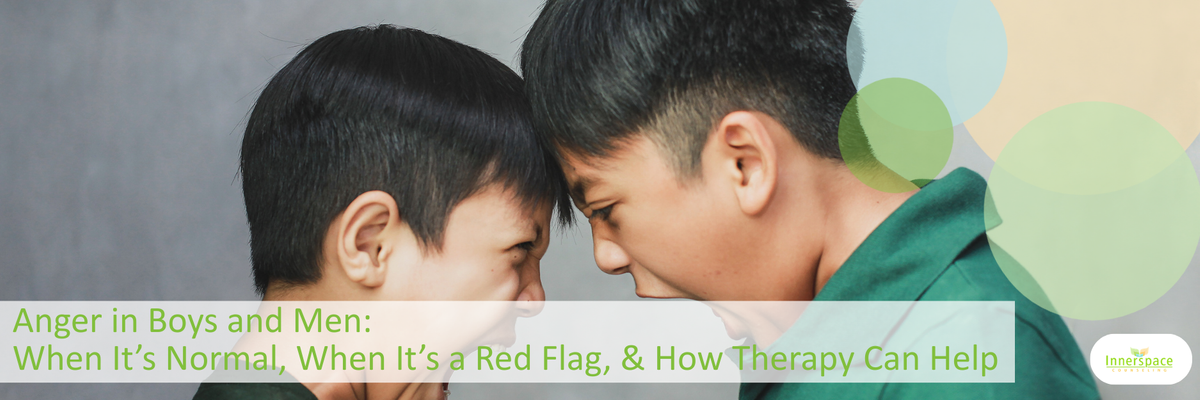
Anger in Boys and Men: When It’s Normal, When It’s a Red Flag, and How Therapy Can Help

Anger isn’t “bad.” It’s a human emotion that can signal hurt, fear, stress, shame, or injustice. But in many boys and men, anger becomes the only emotion that feels “allowed” and that can quietly erode mental health, relationships, school/work performance, and self-esteem.

At Innerspace Counseling, we often see boys, teens, and men who don’t feel sad or anxious so much as irritable, reactive, tense, and easily overwhelmed. That pattern matters because anger can be a surface-level symptom of deeper struggles like depression, anxiety, trauma, or chronic stress, according to the National Institute of Mental Health (NIMH).

Below, you’ll learn what anger looks like across development, what becomes concerning, and what actually helps.

Why anger shows up so often in boys and men

Many boys are socialized to minimize “soft” emotions like sadness, fear, embarrassment, or vulnerability. Anger can become the default emotion because it feels powerful, protective, and more socially acceptable.

As reported by the American Psychological Association (APA), clinically, this matters because depression in men may present less as tearfulness and more as irritability, anger, risk-taking, or substance use, which can delay recognition and support.

Common drivers of anger in boys and men

  • Stress overload (school pressure, work stress, financial strain)

  • Anxiety (anger as a “fight” response to feeling cornered)

  • Depression (irritability, low frustration tolerance, emotional numbness)

  • Trauma and PTSD (hypervigilance, feeling unsafe, reactive nervous system)

  • ADHD and executive function challenges (impulsivity, fast escalation)

  • Sleep deprivation (a major amplifier of irritability)

  • Substance use (lowered inhibition, increased conflict)

  • Family patterns (learned ways of handling conflict)

How anger affects mental health (and the brain-body system)

Anger isn’t just emotional, it’s physiological. When anger spikes, the body shifts toward a threat response: faster heart rate, muscle tension, tunnel vision, and a brain that prioritizes “react” over “reflect.” Over time, frequent anger can increase stress, conflict, shame, and isolation, all fuel for anxiety and depression cycles.

Research also supports a strong link between anger problems and emotion regulation patterns. Strategies like rumination, suppression, and avoidance tend to correlate with higher anger, while strategies like acceptance and cognitive reappraisal correlate with lower anger.

Anger can look different by age

Anger in boys (elementary/middle school)

  • Big reactions to small frustrations

  • Frequent arguments, defiance, or “meltdowns”

  • Physical aggression (pushing, hitting, throwing)

  • Complaints of stomachaches/headaches (stress in the body)

  • Difficulty shifting gears or tolerating “no”

Anger in teen boys

  • Irritability that looks like “attitude”

  • Explosive conflicts with parents and/or teachers

  • Rage after rejection, embarrassment, or social stress

  • Risk-taking or substance use to numb feelings

  • Withdrawal + anger (the “leave me alone” pattern)

The Child Mind Institute notes, irritability and anger can be signs of depression in kids and teens, sometimes replacing sadness.

Anger in men

  • Short fuse, sarcasm, contempt, or “always on edge”

  • Control issues (needing things a certain way to feel okay)

  • Relationship conflict and emotional distance

  • Work problems (reactivity, burnout, resentment)

  • Anger followed by guilt, shame, or emotional shutdown

When anger becomes concerning

Anger deserves support when it starts to create harm, internally or externally.

Yellow flags (time to pay attention)

  • Anger is frequent (most days) or intense (hard to calm down)

  • You feel “flooded” fast and regret what you say/do

  • Loved ones walk on eggshells

  • Anger is paired with anxiety, panic, low mood, or numbness

  • Sleep problems, chronic stress symptoms, or increasing substance use

Red flags (get help soon)

  • Threats, intimidation, property destruction, or physical aggression

  • You’re scared of what you might do when angry

  • Anger is escalating in frequency or severity

  • Legal issues, workplace discipline, or relationship ultimatums

  • Anger plus thoughts of suicide or self-harm

If there is immediate danger (to self or others), seek emergency help right away.

The myth of “venting” and what works instead

A lot of people were taught to “let it out” by punching a bag, screaming, or going for an intense run. But a large meta-analytic review of 154 studies found that arousal-decreasing strategies reduce anger/aggression, while arousal-increasing activities (the “rage it out” approach) were not effective overall.

That doesn’t mean movement is bad—gentle, regulating movement can help. The key is lowering physiological arousal rather than revving it higher.

What can be done: evidence-based anger support (for boys, teens, and men)

1) Learn early warning signs (before the explosion)

Anger often gives a preview:

  • Tight jaw, clenched fists, heat in chest/face

  • Fast thoughts (“This is BS,” “They never listen”)

  • Urge to dominate, win, or escape

In therapy, we practice catching anger at the spark stage instead of the wildfire stage.

2) Build “downshift” skills to calm the nervous system

The research trend is clear: skills that reduce arousal help.

Examples:

  • Slow breathing (longer exhale than inhale)

  • Progressive muscle relaxation

  • Grounding techniques (5-4-3-2-1 senses)

  • Brief “time-outs” with a plan to return and repair

3) Work the thoughts underneath the anger (CBT skills)

Anger is often fueled by fast interpretations:

  • “They’re disrespecting me.”

  • “I’m being treated unfairly.”

  • “I can’t handle this.”

Cognitive-behavioral approaches help people notice, test, and reframe anger-fueling thoughts, and build better coping and communication. The APA notes that psychologists help with anger problems through evidence-based approaches and constructive conflict skills.

CBT-based anger treatment resources are also widely used in clinical settings.

4) Address what anger may be protecting

Sometimes anger is “guarding”:

  • grief

  • shame

  • fear of failure

  • trauma triggers

  • feeling powerless

According to the APA, for many men, treating the underlying depression or anxiety reduces the anger dramatically.

5) For kids/teens: parent coaching + skills practice

With youth, it’s rarely just “fix the kid.” Effective support often includes:

  • parent coaching (limits + connection)

  • predictable routines and sleep support

  • teaching coping skills outside the conflict moment

  • school collaboration when needed

According to the NIMH, for severe irritability and explosive outbursts, emerging research supports targeted CBT approaches (including exposure-based CBT models for irritability/temper outbursts).

How anger is addressed at Innerspace Counseling: what it can look like

People often worry therapy will try to “get rid of anger.” The goal is different:

  • Understand anger’s function (what it’s signaling/protecting)

  • Strengthen emotional regulation

  • Improve communication and conflict repair

  • Reduce shame cycles (“I blew it again”)

  • Build healthier coping for stress, anxiety, depression, or trauma

Treatment within our Intensive Outpatient Program and Partial Hospitalization Program (IOP/PHP) includes:

  • Dialectical Behavioral Therapy (DBT) skill building

  • CBT, including Exposure & Response Prevention (ERP) skills

  • Teen therapy / child therapy with parent sessions

  • Individual counseling

  • Family therapy when conflict patterns are relational

  • Medication Counseling

Quick at-home strategies you can try today

These are not a replacement for therapy, but they help many people start lowering the temperature:

  1. Name it early: “I’m getting activated.”

  2. Change the channel: step away for 10 minutes, not 2 hours (avoid stonewalling).

  3. Slow your breathing: 4 seconds in, 6–8 seconds out for 2–3 minutes.

  4. Use a repair script:

    • “I came in too hot.”

    • “Here’s what I meant.”

    • “Here’s what I need.”

    • “Can we try again?”

  5. Track your patterns: hunger, sleep, alcohol, stress, and specific triggers.

If you’re repeatedly hitting the same wall, that’s a strong signal to get professional support.

FAQ: Anger in boys and men

Is anger a mental illness?

Anger itself is not a diagnosis. But persistent, intense anger can be a symptom of conditions like depression, anxiety, trauma-related disorders, ADHD, or substance use problems and it can seriously affect functioning and relationships.

How do I know if my son’s anger is “normal”?

Occasional anger is normal. It becomes more concerning when it is frequent, intense, aggressive, or impairing, especially if it disrupts school, friendships, or family life, or if it seems tied to persistent irritability or mood issues.

What type of therapy helps with anger?

Evidence-based approaches often include CBT-based treatment, emotion regulation skills, and (for youth irritability) specialized CBT models.

Ready for support?

If anger is affecting your home, relationship, school, or work life, you don’t have to wait for a “rock bottom” moment. Innerspace Counseling offers support for anger in boys, teens, and men, with in our Intensive Outpatient Program and Partial Hospitalization Program (IOP/PHP). Contact us today.